
Skip to content

Real estate professionals

AI for Pittsburgh-area realtors

This page is for Pittsburgh-area realtors and small teams who need follow-up, weekly communication, and a public record that AI tools can verify. Work is built in the agent’s existing tools and handed over. Ownership, running costs and support are agreed in your proposal.

Explore the AI visibility path or the small business path.

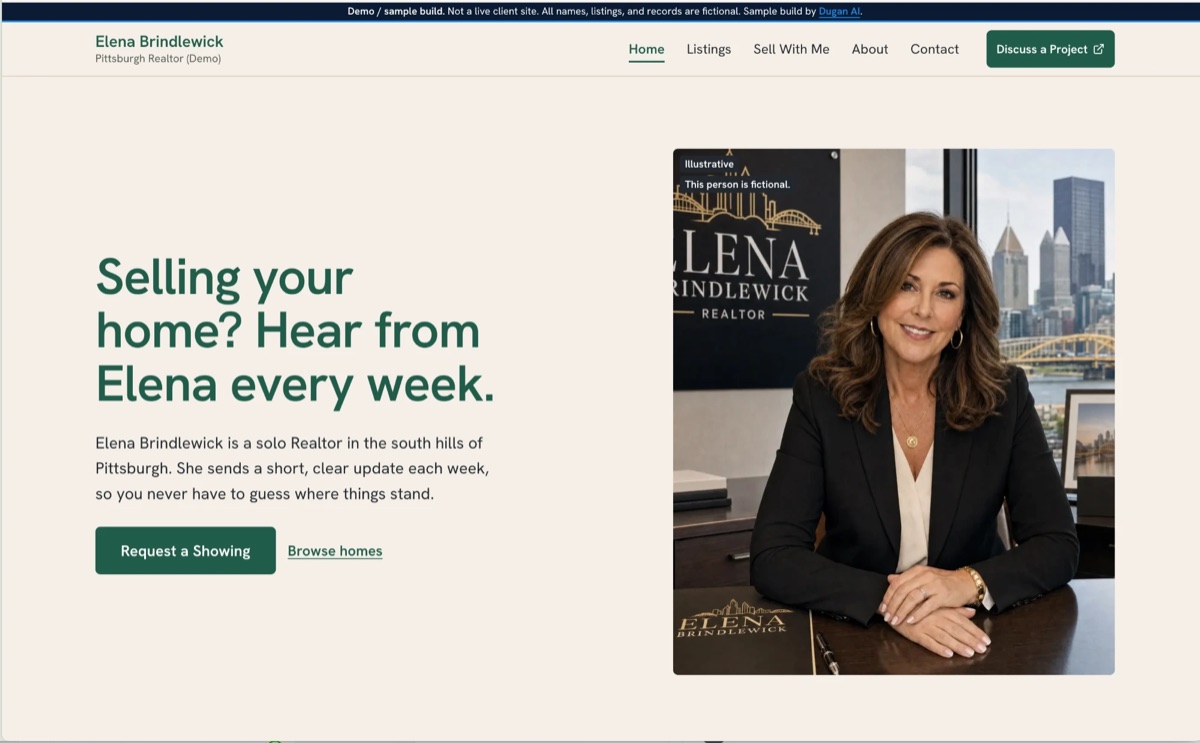
Home page of a live demo website for a fictional Pittsburgh Realtor, Elena Brindlewick: a demo notice at the top, a headline about weekly updates for sellers, and an illustrative portrait of a fictional agent.
Live demo site for a fictional Pittsburgh Realtor. The agent, the listings and every record on it are fictional. It is a sample build, not client work.See the live demo

Illustrative follow-up range

What your follow-up gap could be costing you

See the gap in your own numbers.

Enter a few figures you already know. The result is an illustrative range, not a forecast and not a valuation of your business.

Two different gaps show up in one worksheet: follow-up that cools off, and AI tools that cannot verify you when a buyer asks who to hire.

Show the bands this uses

Slow band 10 / 20 / 35 percent of last year’s units. Mid band 5 / 12 / 22 percent. Fast band 0 / 5 / 10 percent. Applied only after the response and second-touch answers are set. Close rate is inferred from units and leads, then clamped between 0.5 percent and 40 percent.

Two paths

Productivity path

What is the routine work still waiting on you?

Rebuild lead response, follow-up, and listing content so the routine parts of the day stop waiting on you. The Application Blueprint is $950. A Focused Business App starts from $7,500.

AI for leads

Use AI to answer and follow up with leads on your own tools. Build response and follow-up workflows that run on your existing email, CRM, and calendar without handing control to a third-party platform. Learn more about lead response and follow-up.


Visibility path

Can a buyer or seller's AI assistant find and verify you?

Strengthen what AI can find and verify about your business when a buyer or seller asks for an agent in your market. Start with the free AI Visibility Snapshot, then the $350 Readiness Audit if the gaps are clear.

Listings in AI

When people ask ChatGPT for homes, what should your listings be doing? Make listing descriptions, photos, and structured data easier for AI assistants to read, verify, and summarize. Learn more about listings AI can find.

AI: The Operating System for Realtors - inputs, core AI tools, outputs, use cases, and built-in guardrails infographic
How a focused business app fits together for a realtor's business.

Anatomy of an AI Visibility Foundation

Most AI offers in real estate describe a result and hide the method. This one shows the work. Four phases, in the order they happen, with a named deliverable at each step.

  1. Step 1: Diagnose

    Establish a baseline. Ask the assistants what your buyers and sellers ask, and record who gets named.

  2. Step 2: Build

    Correct the record the models read. Business profile, listing consistency, structured data, reviews, and answer content.

  3. Step 3: Validate

    Re-run the same prompts against the same assistants. Compare to the baseline and report what moved.

  4. Step 4: Hand off

    You own every asset and every login. You also keep the measurement method, so you can re-run it yourself.

Ownership, running costs and support are agreed in your proposal. See the full engagement anatomy.

Managed platform versus advisor

Dugan AI is the advisor model.

You leave running the system yourself.

Managed platform
A managed service continues operating some or all of the system for an ongoing fee.
Advisor
An advisor installs the priority layer on your existing accounts and tools, then hands ownership to you.

Diagnose. Build. Validate. Hand off.

Ownership, running costs and support are agreed in your proposal.

  1. Diagnose

    I find where the business is losing time today: work that waits on the owner, follow-up that dies in one inbox, decisions that still live in one person's head. I also note what AI assistants can currently verify. Time lost comes first.

  2. Build

    I build the pages, prompts and workflows in your own accounts and tools.

  3. Validate

    I test the work against a real week of tasks and against the questions AI assistants actually ask.

  4. Hand off

    You keep the files, prompts and documentation. Ownership, running costs and support are agreed in your proposal.

Chris Dugan, founder of Dugan AI LLC
Chris DuganFounder, Dugan AI. Pittsburgh.

Who you work with

I am Chris Dugan, based in Pittsburgh.

25 years in enterprise technology at Microsoft, Google, Oracle and Salesforce. I work in person with agents and small teams across Greater Pittsburgh, the South Hills and Washington County, and remotely elsewhere.

You work directly with me. I define the workflow with you, build it in your own tools and test it against real work before handoff. Ownership, running costs and support are agreed in your proposal.

Questions